
- 512Shares
- Facebook403
- Twitter18
- Pinterest11
- Email55
Fighting humidity at home, 7 rules and tips Humidity problems at home are something we have all experienced at least once. While a house must maintain a certain level of humidity (or “humidity rate”) for the comfort and health of its occupants, it is essential to ensure that it is not too high. Ideally, the humidity in a house should be around 50%, but it can vary between 45 and 65% without causing problems.
More than 65% humidity in your home becomes dangerous for your health, as well as for your house itself: humidity attacks the walls and can lead to infections.
Humidity can come from several factors: bad weather conditions, lack of ventilation, poor insulation of walls,… Fortunately, there are many actions you can take to easily combat humidity.
In this article, we present all the habits you need to adopt to prevent humidity from entering your home. And if it has managed to infiltrate, we will give you some tips and tricks to absorb it!
Note that if you already have traces of mold due to humidity, you will find all the ways to get rid of it in our guide.
Why is it important to fight humidity at home?
Where it is present in excessive amounts, humidity quickly becomes dangerous, both for the house and for its inhabitants. Indeed, it can attack the structure of the house, which could then be seriously weakened.
The consequences can also be significant for your health. Humidity brings with it mold, fungi, and a host of bacteria that will harm your health if you are exposed to them for too long. This can lead to the development of chronic diseases in children. Adults may face respiratory or joint problems or develop new allergies.
Finally, according to some studies, a house that is too humid tends to make us feel gloomy. So there are many reasons to get rid of it as soon as possible!
How to know if humidity is too high?
Excess The presence of humidity can manifest in many forms. This can first be condensation that appears on your windows without being caused by a shower that is too hot or too long.
Humidity also appears on walls and ceilings in the form of stains, halos, bubbles in wallpaper, or paint that cracks and peels. The wood in your furniture or baseboards may start to rot, and traces of mold may also appear here and there, whether on your furniture or on the walls.
Your home may also fill with a musty smell or even be invaded by pests, like cockroaches. Finally, you may even feel the humidity directly on your skin, which becomes sweaty under its effect.
If you want to have peace of mind, there are devices that will allow you to quickly measure the humidity in your home: hygrometers. Note that the most basic models are very inexpensive but are not always 100% reliable. So it’s best to know before buying.
Rules to follow for humidity leaks
To maintain a healthy humidity level in your home, there are several rules to follow daily as well as several checks to perform regularly. Here they are.
1) Ventilate and air out
The golden rule in the fight against humidity is ventilation. It is very important to ventilate the rooms of the house for 5-10 minutes every day. Not only will you renew the air, but you will also let out the excess humidity.
Humidity is mainly present in the kitchen and bathroom. In these rooms, it is therefore necessary to double your efforts and ventilate directly after taking a bath or shower, or after cooking. Ideally, it is best to start ventilating these rooms as soon as they are used. The best thing is to use a ventilation system in your bathroom and always use the hood when cooking something.
2) Dry your laundry in the right place
Laundry that has just been washed is also a significant source of humidity: when drying, water evaporates and… settles on the surrounding walls. It is therefore always better to dry it outside or in a very ventilated area.
3) Do not block vents
Today, newly built houses are increasingly insulated to prevent heat from escaping outside. While it is important to have a well-insulated house, it is not necessary to overdo it: too much insulation will be a source of humidity!
For example, in some houses, there are ventilation vents whose role is precisely to combat this problem. Above all, do not place anything in front of them that would prevent air from passing through.
Similarly, if you have an electric ventilation system, do not turn it off. Let it do its job instead.
4) Check the sealing of your home
That said, it is obviously important to have a well-sealed house. Regularly walk around your house to check for cracks in the walls and that the roof and windows are completely waterproof. Inside your home, also check the seals of your sinks, showers, and bathtubs.
If you notice a leak or lack of sealing, do not delay in changing the seals or filling the crack. If you notice traces of water infiltration in your walls, it is best to call a professional to determine the exact cause and the procedure to follow. Do not cover your wall with a waterproof product or anything else that will only serve to hide humidity problems: if you do not eliminate them before doing so, your wall will be even more degraded in the long term.
If your windows are single-glazed, replacing them with double glazing will greatly help in combating humidity and condensation.
5) Monitor the arrival of capillary rises
Capillary rises are traces of humidity found at the bottom of our walls: they come from the ground and rise up the wall. There are several reasons for this phenomenon, including the nature of the ground on which the house is located or insufficient rainwater drainage.
In any case, this is a problem that must be taken very seriously as it damages the walls of the house. If you notice one at home, you will need to contact a professional.
Some tips to absorb humidity
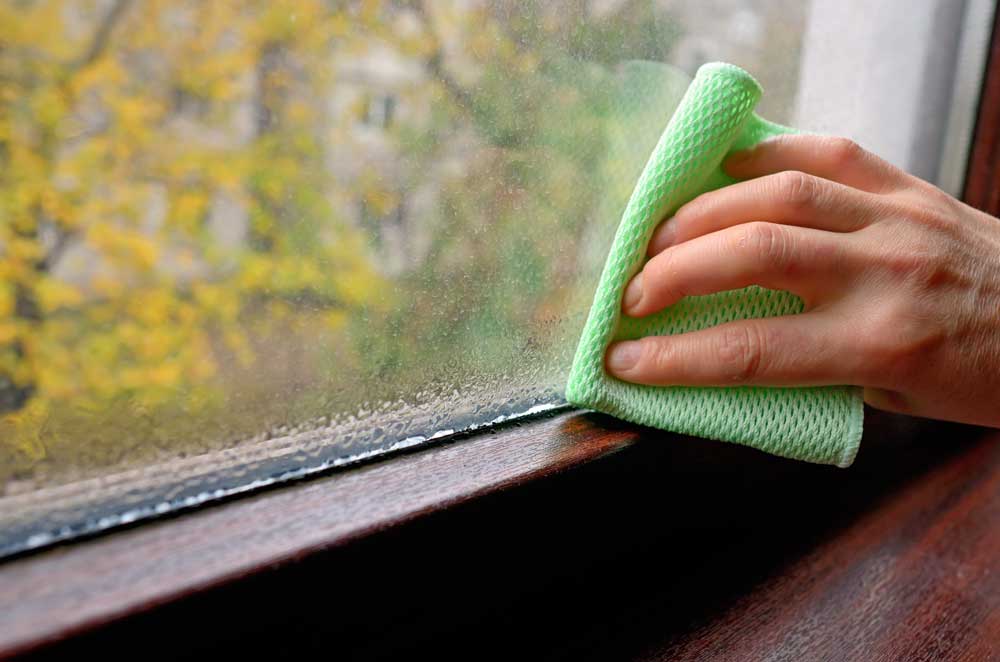
First of all, note that the best way to tackle a problem is to address its cause. With humidity, it’s the same: you can only get rid of it completely if you eliminate what brings it back into the house once and for all. To determine the cause, it is sometimes necessary to call a professional, who will be able to make a real and complete diagnosis of your problem. However, while waiting for the diagnosis and any potential work needed to get rid of it, there are some solutions available to quickly combat humidity.
If you have followed all the rules to escape humidity, but it is still too high, it is time to place “traps” for humidity: they will help absorb the excess humidity in the ambient air. Here are two of them that are entirely natural and low-cost.
1) Homemade dehumidifier
You can find commercial dehumidifiers. However, you can also easily create one yourself.
Take a plastic bottle and cut it in half so that you have the bottom of the bottle on one side and the top on the other. Remove the cap and replace it with a compress or cotton, which you will hold with a rubber band. Then pour coarse salt into the bottom of the bottle. As a guideline, for a room of 25m², you will need about 150 grams of coarse salt. For best results, put your coarse salt in the refrigerator for at least 10 hours before using it.
Finally, place the part with the cap on the other part, so that the cap slides inside the bottle without touching the salt.
Place your homemade dehumidifier in the room that has too much humidity. You will need to change the salt every 4 days or so. Note that you can even reuse the salt up to 5 times by simply drying it in the oven for about half an hour before putting it back in the bottle.
2) Gum Arabic
Use scented gum arabic and place it in the rooms, but also in your closets if necessary. In addition to dehumidifying your home, it will leave a pleasant scent.
Do you have humidity problems in your home? What is your secret for combating them?
Another interesting resource on
humidity Sources
https://thermometre-1.com/taux-humidite-ideal/ http://humiditeideale.fr/humidite-ideale-temperature-air-taux-nefaste-climat https://energieplus-lesite.be/theories/l-enveloppe/le-comportement-des-materiaux/la-formation-de-moisissures/ https://www.scopus.com/record/display.uri?eid=2-s2.0-0022560410&origin=inward&txGid=0bb4d8e2fa5c40c42e9fbe24ff2fb176 https://www.scopus.com/record/display.uri?eid=2-s2.0-84955585220&origin=inward&txGid=03a60fd6ea710ed4821ea55d21007cf4 https://www.cchst.ca/oshanswers/phys_agents/heat_health.html https://www.epa.gov/indoor-air-quality-iaq/care-your-air-guide-indoor-air-quality-printable-version About the author
 A graduate of the Louvain School of Journalism, Léonor Rogister turns away from the world of daily news to focus on the lifestyles of current events. Loving food and simple happiness, she enjoys staying informed about everything related to well-being, in whatever form it takes.
Leonor has been an expatriate since 2015 and has made her home in several countries. When she is not traveling, she enjoys the comfort of home. She has also maintained a blog for years where she shares her passion for travel.
Facebook — Linkedin
 While I have you here, why not take the opportunity to subscribe to our newsletter? Simple and free, your email will remain confidential, I promise.
I will be able to keep you updated on news, tips, and anything that could contribute to your well-being. This way!
Content JTNDC2NYAXB0JTIWYXN5BMMLMJBZCMMLM0QLMJILMKYLMKZWYWDLYWQYLMDVB2DSZXN5BMRPY2F0AW9ULMNVBSuyRNBHZ2VHZ2VHZCuyRMPZJTJTJGYWRZYWRZYNLNLNLNLNLNLNB2NB0NB0NB2NB0NB0NB0NB2B2B2B2B229NB29NBGuuanMLMJilM0ULM0MLMKZZY3JPCHQLM0ULMeelM0NPBNMLMJBGFZCYUZRCUYMMFKC2J5Z29VZ2XLJTIYJTBBJTIWJTIWJTIWJTIWC3R5BTIWC3R5BGULM0C3R5BGULM0QLM0QLM0LM0LM0QLM0JKAXNWJMMMMMJJJJJJJJJMMMMMMMJJJJJJJJTIBGF5JTNBYMXVY2SLMJilMeelMJalmJalmJalmJalmJbKYXRHLWFKLWZVCM1HDCuzRCuyMMF1DG9YZWXHEGVKJTIYJTibJTibTIWJTIWJTIWZGF0YS1HZC1JBGLLBnQLBnQLBnQLBnQLM0LM0LMJJJJJTYJJJJJJJJJJJJJJJJJMJJJJJJJJJJJS1WDWitnZI3MJA5MJYZNJE5MZK2NYUYMIUWQSuyMCuyMCuyMCuyMGrHdGetYWQTC2XVDCuyMJCXNJYZNTE0OTMLMJILM0ULM0ULM0ULM0MLM0MLM0MLM0MLM0MLM0MLM0MLM0Meelm0nzy3jpchqlm0ulmeelmjalmjalmjalalmjalmjhhzhniewdvb2Dzsuymcuzrcuymhdpbmrvdy5hzhniewdvb2dszsuymcu3qyuymcu1qiu1rcuyos5wdxnojti4jtdcjtdejti5jtncjtbbjtjtjtjgc2nyaxb0jtnf she enjoys staying informed about everything related to well-being, in whatever form it takes.
Leonor has been an expatriate since 2015 and has made her home in several countries. When she is not traveling, she enjoys the comfort of home. She has also maintained a blog for years where she shares her passion for travel.
Facebook — Linkedin
While I have you here, why not take the opportunity to subscribe to our newsletter? Simple and free, your email will remain confidential, I promise.
I will be able to keep you updated on news, tips, and anything that could contribute to your well-being. This way!
Content
Tag : cleaning moisture stains on a wall