
A nine-year-old German shepherd struggling to get into the car, a labrador limping after the morning walk: when arthritis sets in, one quickly looks for an alternative to long-term anti-inflammatories. Harpagophytum, nicknamed devil’s claw, comes up in almost every discussion among pet owners. The plant has a documented anti-inflammatory activity, but its use in dogs deserves a more honest framing than what is generally read.
Harpagoside and joint inflammation: what the plant really does
Harpagophytum procumbens concentrates iridoids, including harpagoside, in its secondary roots, which is responsible for most of its activity. In cellular models and in humans, this molecule reduces the production of inflammatory mediators. This is a solid fact, confirmed by reference organizations in phytotherapy.
The problem lies in the transfer to dogs. Direct clinical evidence in dogs remains very limited. Most of the arguments put forward by supplement manufacturers come from human studies or in vitro work. This is not the same as a controlled trial on arthritic dogs, with a placebo group and veterinary follow-up. We are not saying it doesn’t work; we are saying we lack data to quantify the actual effect on canine joint pain.
In practice, many owners report an improvement in mobility after a few weeks of treatment. Feedback on this point varies, and it remains difficult to separate the effect of the plant from a simultaneous adjustment of physical activity or weight. When using harpagophytum for dog arthritis, one is engaging in a complementary approach, not a primary treatment.

Drug interactions and contraindications of harpagophytum in dogs
This is the least addressed angle in articles praising the plant, yet it is the most concrete when one has a dog already under treatment. Combining harpagophytum with non-steroidal anti-inflammatory drugs (NSAIDs) without veterinary advice is risky. Both act on the same inflammatory pathways, and the combination can amplify digestive side effects: vomiting, diarrhea, gastric ulcers.
The same reasoning applies to corticosteroids. A dog on cortisone for another condition should not receive harpagophytum concurrently without veterinary validation.
Cases where caution is required
- Dogs suffering from liver or biliary disorders: the plant stimulates bile secretion, which can worsen certain liver or gallbladder conditions
- Pregnant or nursing females: lack of safety data in this context
- Dogs on anticoagulant or antidiabetic treatment, due to poorly documented potential interactions in animals
The simple rule: show the product to the veterinarian before starting, especially if the dog is already taking medication.
Multimodal approach to canine arthritis: where to place phytotherapy
Recent recommendations, particularly those from the AAHA published in 2022, describe a multimodal management of arthritis. The idea is not to find the miracle product, but to combine several levers whose effectiveness accumulates.
The pillars before any supplement
- Weight control: an overweight dog puts stress on its joints with every step. This is the most effective and underestimated lever
- Appropriate physical activity: short and regular walks are better than a long outing on the weekend. Swimming or walking on soft ground preserves cartilage
- Environmental adjustments: ramp to get into the car, non-slip mats on the tiles, orthopedic bedding. These adjustments change the dog’s daily life
- Omega-3 EPA/DHA: among nutritional supplements, these are the best documented for arthritic dogs according to AAHA 2022 recommendations
Harpagophytum serves as an additional layer in this framework. One does not start with the plant while ignoring weight or exercise. An obese dog on harpagophytum will remain painful.
Joint supplements: not all are created equal
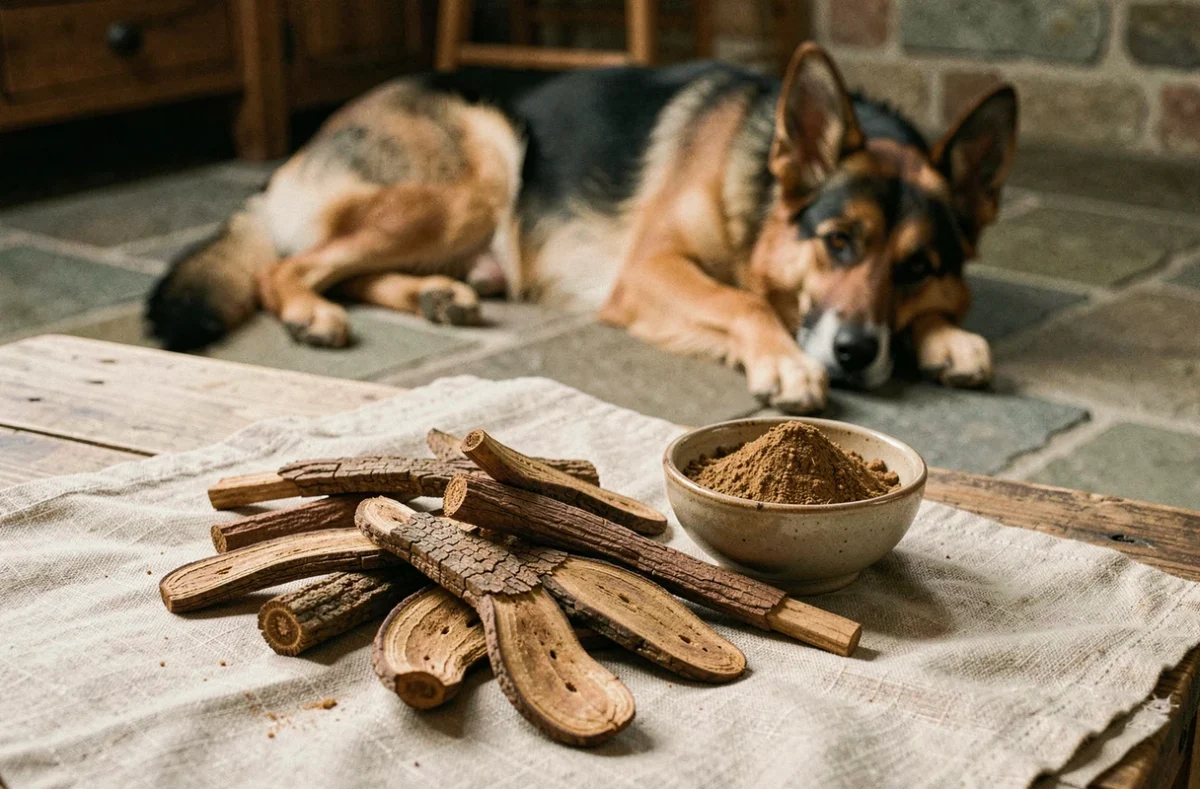
The market offers dozens of harpagophytum-based products for dogs, in the form of powder, tablets, or gels. The concentration of harpagoside varies greatly from one product to another. A poorly dosed supplement will not have the same potential as an extract standardized in active ingredients. One should check the label for the harpagoside content, not just the generic mention “harpagophytum.”
The method of administration also matters for compliance. A picky dog will refuse a bitter tablet but will accept a powder mixed with its food. The duration of treatment is measured in weeks: effects are not immediate, and stopping after five days does not allow for an evaluation of the dog’s response.
Veterinary phytotherapy: what can be reasonably expected
Using harpagophytum for an arthritic dog is a coherent choice as long as one does not expect what it cannot deliver. The plant does not regenerate cartilage. It does not reverse the disease. It can help reduce joint discomfort as part of a comprehensive management plan.
The veterinarian remains the central prescriber in pain management. When arthritis progresses and limping becomes permanent, prescribed analgesics are sometimes necessary. Phytotherapy is not meant to replace them, but it can support the dog over time, between flare-ups, limiting the need for heavier molecules.
A well-managed arthritic dog is primarily one with controlled weight, appropriate activity, an adjusted environment, and possibly a supplement like harpagophytum validated by the veterinarian. In that order.