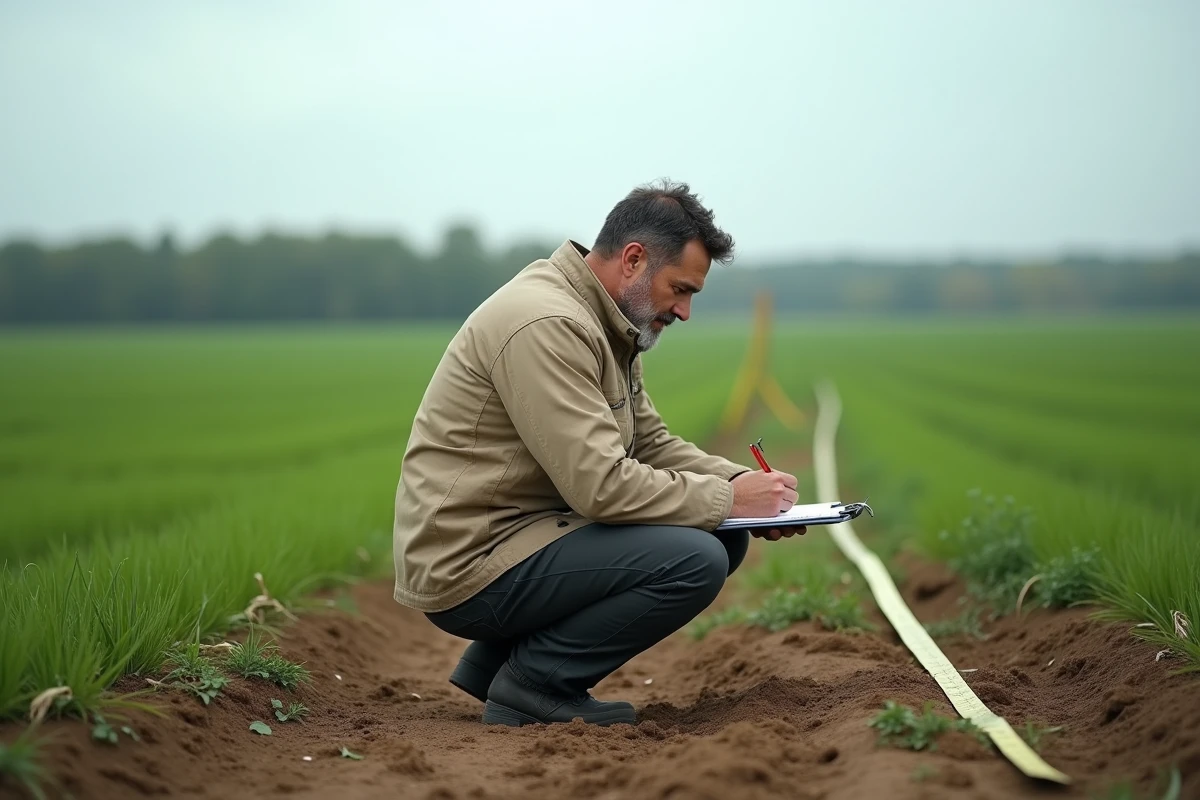
When obtaining a land registry statement or a sales deed, the area is often expressed in hectares, ares, and centiares. Three units inherited from the historical metric system, still prevalent in French land documents. Converting these values into square meters allows for comparing a plot of land with the thresholds of the PLU, checking a footprint, or simply understanding what one is buying.
Why the cadastre still uses hectares, ares, and centiares
The cadastral matrices of many French municipalities still record parcels in the h-a-ca format (hectares, ares, centiares). This format dates back to the establishment of the are as a republican measure of area for land. Surveyors and notaries retain it by professional convention.
However, European regulations on SI units impose the square meter as the reference. In recent notarial deeds, the main area is now listed in square meters, with mentions in hectares, ares, and centiares appearing only as supplementary indications, especially for agricultural and forest lands.
Thus, one regularly encounters a document that displays “2 ha 35 a 12 ca” without providing the equivalent in m². To process a building permit request or calculate a floor area, one must master the conversion of hectare, are, and centiare to m² oneself.
Converting hectare, are, and centiare to square meters: the mechanics
The principle is based on a constant ratio between each unit. One hectare equals 10,000 m², one are equals 100 m², one centiare equals 1 m². Each level corresponds to a multiplication by 100.

To convert an area expressed in h-a-ca, one breaks down each component and then adds them up:
- Multiply the number of hectares by 10,000 to get the part in m².
- Multiply the number of ares by 100 to get the part in m².
- Keep the number of centiares as is, since one centiare equals one square meter.
- Add the three results to obtain the total area in m².
Let’s take a plot listed as 3 ha 27 a 48 ca. We calculate: 3 x 10,000 = 30,000, then 27 x 100 = 2,700, then 48. Total: 33,148 m². The logic remains the same regardless of the size of the land.
Reverse calculation: from square meters to h-a-ca
Divide the total area in m² by 10,000 to extract the hectares. The remainder is divided by 100 for the ares. What remains gives the centiares. For 23,145 m²: 2 ha (20,000 m²), 31 a (3,100 m²), 45 ca.
A common mistake is to forget that each level is a factor of 100, not 1,000. One does not shift three places as with length units, but two. A conversion table for areas has columns in pairs, not in groups of three.
Quick conversion table between area units
| Unit | Equivalence in m² | Relation |
|---|---|---|
| 1 centiare (ca) | 1 m² | Base land unit |
| 1 are (a) | 100 m² | 100 centiares |
| 1 hectare (ha) | 10,000 m² | 100 ares |
| 1 km² | 1,000,000 m² | 100 hectares |
This table covers almost all cases encountered in a real estate or agricultural context. The square kilometer only appears for very large areas (state-owned forests, large-scale farming operations).
Concrete cases where conversion changes the interpretation of a file
On a building permit, the floor area and footprint are required in square meters. If the local urban plan sets a footprint threshold, comparing this threshold to a plot expressed in ares without conversion leads to sizing errors.
In agriculture, operating aids are sometimes calculated based on areas declared in hectares. Checking the consistency between the CAP declaration and the cadastral statement requires juggling between the two formats. A discrepancy of a few ares, which seems negligible on paper, represents several hundred square meters.
Common pitfalls in sales deeds
Authentic deeds mention the area in hectare, are, centiare. Some sellers round off, others confuse are and centiare. In a transaction, the difference between 5 a and 5 ca shifts from 500 m² to 5 m², a factor of 100 that alters the value of the property.
- Always check that the h-a-ca mention in the deed corresponds to the area in m² indicated by the surveyor.
- Compare the cadastral area with the actual measured area, as old plans may have discrepancies.
- Ensure that annexes (garages, cellars) are not included in the land area of the plot.
A discrepancy of just one are represents 100 m², equivalent to a small apartment. In a tight market, the financial impact is direct.
Square meters and urban planning: why conversion is not always enough
Having the area in m² does not close the question. Urban planning documents distinguish between floor area, footprint, and cadastral area. These three concepts do not overlap.
The cadastral area of a plot sometimes includes non-buildable portions (flood zones, easements, classified wooded areas). Converting hectares to square meters gives the gross area, not the usable area in the sense of the PLU. For a construction project, one must cross-reference the conversion with the regulatory constraints of the municipality.
Feedback on this point varies according to urban planning services: some accept the cadastral area as is, while others require a contradictory boundary survey by a surveyor. The conversion from hectare-are-centiare to square meters remains the starting point, but it does not replace professional measurement or careful reading of the zoning regulations.